



Static Angular SSR: Nice URLs and good SEO - you can't have both (but here's a fix!)
I love Angular. But when it comes to prerendered static sites, Angular is surprisingly far behind other major frameworks. Astro, Next.js, SvelteKit: they all let you choose how your pages are written to disk. Angular doesn't.
And static sites are great: hosting is literally free, and a CDN serves your pages to the whole world and scales like a beast. That's why the websites of Angular.Schule and the Angular book are prerendered static sites.
But here comes the catch! Prerender your app, deploy it to a static host (for example GitHub Pages, Cloudflare Pages or Firebase Hosting), and take a look at the network tab: every direct visit starts with a redirect to the same URL with a trailing slash, and a moment later the Angular router quietly removes the slash again. It looks great in the address bar, but technically, for search engine optimization, it's a nightmare. You can get rid of the redirect, but only by putting a trailing slash on every URL of your site. Nice URLs or good SEO: with Angular's prerendering, you can't have both. In this article, I explain why, and how to get both today.
Contents
- Today: nice URLs or good SEO, you can't have both
- Why does Angular do this?
- How do other frameworks handle this?
- With
@angular-schule/prerender-format: nice URLs and good SEO, we deserve both! - The real fix: an option in the Angular CLI
- Two things to watch out for
- Conclusion
Today: nice URLs or good SEO, you can't have both
Angular's prerendering (SSG) writes every route into its own folder.
Take the article you are reading right now: with Angular's default, the route blog/2026-09-static-angular-ssr-trailing-slash becomes blog/2026-09-static-angular-ssr-trailing-slash/index.html.
For the rest of this article, let's call it blog/my-article.
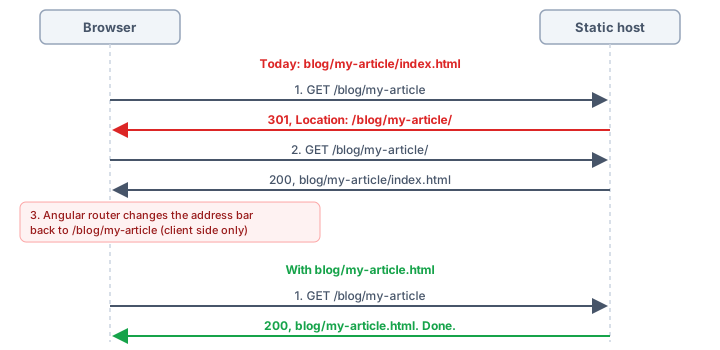
A static host like GitHub Pages or Cloudflare Pages sees a request for /blog/my-article, finds a folder with that name and redirects to /blog/my-article/.
$ curl -I https://example.com/blog/my-article
HTTP/2 301
location: https://example.com/blog/my-article/
The browser follows the redirect, gets the index.html, Angular starts, and the router normalizes the URL back to /blog/my-article.
So you have to choose:
- Nice URLs, but redirects: Your links use
/blog/my-article. Every direct visit (a search engine, a bookmark, a link shared on social media) starts with a redirect to/blog/my-article/, and the Angular router then removes the trailing slash again. The URL in your links is never the URL that actually answers. - No redirects, but trailing slashes everywhere: Your links have to use
/blog/my-article/. Pages answer directly, but every URL ends with a slash, and Angular needs an extra provider to keep it in the address bar:{ provide: LocationStrategy, useClass: TrailingSlashPathLocationStrategy }(seeTrailingSlashPathLocationStrategy).
Why does Angular do this?
The file name is decided in exactly one place in the Angular CLI, the function getRouteOutPath() in @angular/build:
function getRouteOutPath(route: string, baseHrefPathname: string): string {
  const routeWithoutBaseHref = getRouteWithoutBaseHref(route, baseHrefPathname);

  return stripLeadingSlash(posix.join(routeWithoutBaseHref, 'index.html'));
}
Every route ends up as <route>/index.html.
There is no option to change that.
This layout works on every web server, which makes it a good default.
But many static hosts can do better: they serve blog/my-article.html under /blog/my-article, directly, without a redirect.
Angular just never writes blog/my-article.html.
How do other frameworks handle this?
Static site generators have offered this choice for a long time. Angular is the odd one out:
| Framework | Option | blog/my-article/index.html |
blog/my-article.html |
|---|---|---|---|
| Astro | build.format |
'directory' (default) |
'file' |
| Next.js (static export) | trailingSlash |
true |
false (default) |
| SvelteKit | trailingSlash |
'always' |
'never' (default) |
| Nuxt 2 | generate.subFolders |
true (default) |
false |
| Hugo | uglyURLs |
false (default) |
true |
| Angular | – | always | – |
Next.js and SvelteKit even write blog/my-article.html by default.
And the Astro documentation recommends build.format: 'file' together with trailingSlash: 'never', which is the combination Angular can't produce today.
With @angular-schule/prerender-format: nice URLs and good SEO, we deserve both!
The fix is surprisingly small: write blog/my-article.html instead of blog/my-article/index.html.
Until Angular can do this on its own, the builder @angular-schule/prerender-format can do the job.
In fact, you are looking at it right now.
The Angular.Schule website is built with it, and this article is served from blog/2026-09-static-angular-ssr-trailing-slash.html.
Open the network tab and reload: no redirect, just a clean URL.
- Nice URLs:
/blog/my-article, without a trailing slash, in your links, in the address bar and in the server response alike. - Good SEO: every page answers directly. Search engines see no redirect, and the URL they crawl is the same one your links point to.
And yes, blog.html and the folder blog/ can live side by side: the host serves /blog from the file and /blog/my-article from the folder.
Installation
ng add @angular-schule/prerender-format
ng build
ng add swaps the builder of your build target and sets the new option prerender.format:
"build": {
  "builder": "@angular-schule/prerender-format:application",
  "options": {
    "outputMode": "static",
    "prerender": {
      "format": "file"
    }
  }
}
"directory"(default):/blog/my-articleis written toblog/my-article/index.html, as today."file":/blog/my-articleis written toblog/my-article.html.
I borrowed the terminology from Astro: build.format with 'directory' and 'file' became prerender.format with the same values.
All other options stay as they are, the builder passes them on to @angular/build:application.
The option is made for static builds, by design.
An ssr entry is fine as long as outputMode is "static": Angular then uses it only during ng build to prerender the pages, and no server is deployed.
If your build deploys a server ("outputMode": "server", or ssr without outputMode), the option is not considered: you get a warning, and the pages are written to <route>/index.html.
With a server, there is nothing to fix anyway: the Node.js server generated by Angular serves static files with redirect: false, so /blog/my-article is never redirected to /blog/my-article/ in the first place.
How it works
The builder calls buildApplication() from @angular/build and replaces the internal function prerenderPages() at runtime, to rename the files before they are written.
That's a hack.
It relies on internal APIs, which is why I narrowed it down to Angular 22 only.
But it's a well-tested hack: it writes the same files as my patch for the Angular CLI, and it runs on the websites of Angular.Schule and the Angular book.
I hope I don't have to maintain this package longer than necessary, because I have also prepared a sustainable fix.
The real fix: an option in the Angular CLI
A built-in option for the Angular CLI is the clean solution. My colleague Ferdinand Malcher opened an issue for this back in 2024: angular/angular-cli#29173, "SSG/Prerendering: Allow generating foo.html instead of foo/index.html". It didn't collect enough votes in the community voting process back then. That's a pity. Let's hope the problem gets more attention now.
So I wrote the pull request myself: angular/angular-cli#34180 adds the same option prerender.format to Angular's own application builder:
"build": {
  "builder": "@angular/build:application",
  "options": {
    "outputMode": "static",
    "prerender": {
      "format": "file"
    }
  }
}
Once it lands, you only switch the builder name back to @angular/build:application.
That's the plan.
If you want this in Angular, please give the issue a 👍. Upvoting the pull request could be helpful, too! :-) The Angular team decides based on community votes.
Two things to watch out for
A route called index
With 'file', a route /index is written to index.html, the file of your start page.
A route /blog/index becomes blog/index.html, which web servers serve for /blog/.
So if you use 'file', don't call a route index.
Previewing the build locally
ng serve renders your pages on the fly and never reads the files in dist/.
To see exactly what your static host will serve (for example several locales under one origin), you need a small server for the dist folder.
If you write it with Express, watch out: with blog.html next to the folder blog/, express.static finds the folder first and redirects /blog to /blog/.
Add a small middleware in front of it that sends blog.html directly:
app.use((req, res, next) => {
  if (req.path.endsWith('/') || path.extname(req.path)) { return next(); }
  const file = path.join(distFolder, decodeURIComponent(req.path) + '.html');
  if (file.startsWith(distFolder) && fs.existsSync(file)) { return res.sendFile(file); }
  next();
});
app.use(express.static(distFolder));
Conclusion
Angular's prerendering writes every route into a folder, and static hosts answer that with a redirect to a trailing slash. Today, you have to choose between nice URLs and a site without redirects.
We deserve both.
Write <route>.html instead of <route>/index.html, and static hosts serve your pages directly under clean URLs.
Until Angular supports this natively, two commands are enough. ng add updates your angular.json (new builder, prerender.format: "file"), and ng build writes the files:
ng add @angular-schule/prerender-format
ng build
And if you'd like to see this in Angular itself, please vote for the issue and the pull request. 🚀
Further Reading:
- angular/angular-cli#29173: SSG/Prerendering: Allow generating foo.html instead of foo/index.html
- angular/angular-cli#34180: feat(@angular/build): add
prerender.formatoption @angular-schule/prerender-formaton npm and on GitHub- Astro:
build.format - Angular: Server-side and hybrid rendering
- Angular:
TrailingSlashPathLocationStrategy
Header image: photo from pxhere (CC0), Angular logo by Google (CC BY 4.0).
Keywords:AngularAngular 22SSRSSGPrerenderingStatic Site GenerationoutputMode staticTrailing SlashRedirectSEOGitHub PagesCloudflare PagesAstro build.formatprerender.formatTrailingSlashPathLocationStrategy
Anregungen? Feedback? Fehler?
About Johannes Hoppe
 Johannes Hoppe is a trainer, consultant and developer specializing in Angular. He is a co-author of the Angular book (in German language), together with Ferdinand Malcher and Danny Koppenhagen. After four successful editions, they have rewritten the book from scratch – with modern syntax, compact and covering many new topics. The new book is out now. More info at angular-buch.com